Learn about heat exchangers and their different types, how they work, their uses in heating and cooling systems, and the most important factors affecting their efficiency and choosing the appropriate type.
Heat exchangers and their types are among the most important topics related to heating, cooling, and water heating systems, because they explain how heat is transferred efficiently inside the devices we use daily, such as heaters, boilers, air conditioners, and refrigerators, as well as inside factories and power plants.
In this article, we learn about heat exchangers and their types, how they work, and the most important factors that affect their efficiency, while clarifying their uses in daily life and industrial and home systems.
What are heat exchangers and their types?
A heat exchanger can be defined as an engineering device designed to transfer thermal energy from one medium to another with high efficiency, whether this transfer takes place between two liquids, or between a gas and a liquid, or even between a liquid and a solid surface without the two media mixing together.
Although the sizes and complexity of heat exchangers vary depending on the nature of operation, their basic configuration remains constant. It passes heat from the higher temperature environment to the lower temperature environment, which contributes to raising the efficiency of the entire system and reducing energy loss.
Types of heat exchangers and their uses in heating systems
Choosing a specific type of heat exchanger depends on the nature of your home's heating system, the operating environment, and how resistant the materials are to corrosion and rust. Because Abu Hajar Company is interested in engineering design that ensures stable, long-term operation, it focuses on the best types of heat exchangers as follows:
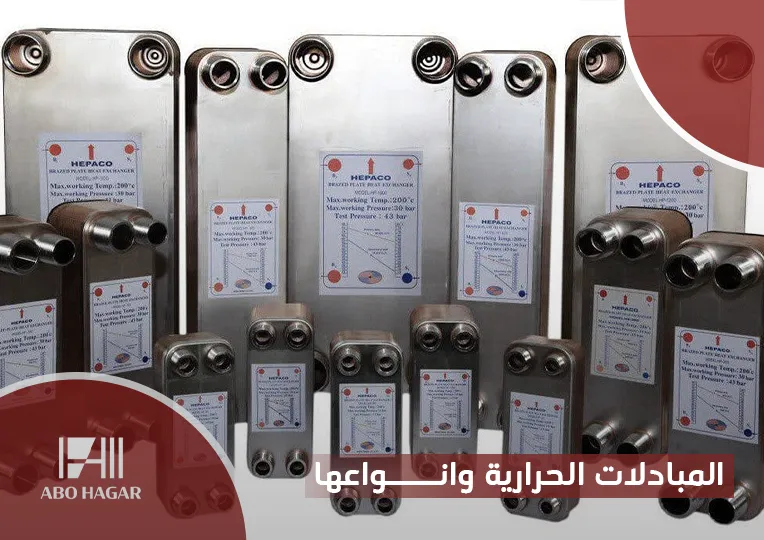
1. Plate Heat Exchanger
- His business idea: It consists of several thin metal plates in succession. Fluids flow in insulated passages between these plates, allowing heat to be transferred very quickly through the plate material without any mixing.
- Use in heating: It is the first and primary choice in central heating and air conditioning (HVAC) systems and instantaneous water heating for villas.
- Its advantages: It is characterized by its small, space-saving size, very high thermal efficiency, easy disassembly and cleaning, and great efficiency even at low fluid flow rates.
2. Finned-Tube Heat Exchanger
- His business idea: It relies on pipes through which the hot liquid passes, and the outer part of which is provided with “fins” or fine metal blades to increase the heat transfer surface area. Which accelerates the process of heat exchange with the surrounding air.
- Use in heating: It is widely used in central air cooling and heating systems, heating and ventilation (HVAC) systems, and hot air heaters.
- Its advantages: It is characterized by its simple structure and very high efficiency in dealing with large quantities of gases or liquids and distributing warmth in the place quickly.
How do heat exchangers contribute to increasing the efficiency of central heating systems?
Heat exchangers in heating systems are among the most important components that determine the efficiency and stability of the system, as they are mainly responsible for transferring heat between different circuits with the least possible losses. Therefore, choosing a suitable heat exchanger for boilers and central heating systems helps improve system performance, providing hot water more quickly and stably, while reducing energy consumption in the long term.
The most important benefits of using high-efficiency heat exchangers:
-
Improving the speed of heat transfer between the heating source and distribution units.
-
Maintain a stable water temperature within the heating system.
-
Reducing heat loss and increasing boiler operating efficiency.
-
Providing suitable solutions for villas and buildings that need integrated central heating.
-
Increase the lifespan of components by choosing materials that are resistant to corrosion and deposits.
-
Improving the performance of water heating and heating systems together within the same system.
Design of heat exchangers and the most important factors affecting efficiency and performance
The performance of heat exchangers does not depend only on their type, but is also affected by the method of design and quality of maintenance. When studying heat exchangers and their types, we find that intelligent engineering design is the secret behind improving heat transfer and reducing energy bills.
Among the most important factors that Abu Hajar engineers focus on to ensure the efficiency and optimal performance of heat exchangers and their types:
- Selection of materials and thermal conductivity: We rely on metals with superior conductivity and complete corrosion resistance (such as stainless steel and copper), ensuring a long service life for the equipment.
- Heat exchange surface area: We use plate or finned tube technologies to increase exchange area and maximize performance, without increasing the size of the equipment in your home.
- Arrange and direct fluid flow: We engineerly rely on the “Counter-flow” system because it achieves the highest heat transfer rate compared to parallel flow.
- Suitable size and sediment resistance: We carefully calculate the size of the system to suit your needs to reduce costs, while choosing designs that resist the accumulation of salts and impurities for easy cleaning.
Correct installation and regular inspection are the secret to sustainable heating; Contact Abu Hajar experts now and request your free inspection for 2026.
How to choose the appropriate type of heat exchanger according to use and application
Choosing the ideal type of heat exchanger depends on the nature of the target application in your home or project. When understanding heat exchangers and their types, it becomes easy to identify the basic technical points to ensure higher operational efficiency and longer lifespan, the most important of which are:
- Determine the nature of use: Is the system needed for home heating, pool water heating, or central air conditioning?
- Knowing the type of medium and fuel: Determine the nature of the materials passing through the system (water, air, steam, or gas).
- Calculate temperature and pressure: Study the required temperatures, fluid flow rate and operating pressure with engineering precision.
- Smart material and size: Choose a material that resists salt and corrosion, and choose a size that exactly matches the building’s needs without increasing or decreasing.
- Ease of maintenance: Ensure that the heat exchanger design chosen is easy to disassemble and periodically clean from deposits.
Because calculations of thermal conductivity, flow rates, and safety details require precise engineering expertise; Relying on Abu Hajar Company guarantees that you will choose and install the most efficient system for your home in 2026 with the highest European quality standards and the lowest operating cost with a quick return.
Choosing the right heat exchanger for boilers and water heating systems
The success of the heating system depends not only on the type of boiler, but is also related to choosing the appropriate type of heat exchanger depending on the nature of use, the size of the thermal loads, and the type of water used within the system. The heat exchanger for hot water or boilers needs a precise design that ensures the highest rate of heat transfer while maintaining efficient operation and ease of maintenance.
Important factors when choosing a heat exchanger:
-
Determine the required system capacity before choosing the size and type of heat exchanger.
-
Choose the appropriate material, such as stainless steel, to resist corrosion and salts.
-
Consider operating pressure and temperatures to ensure stable performance.
-
Choose a design that facilitates cleaning and regular maintenance.
-
Relying on specialized engineering expertise to ensure compatibility of the exchanger with the boiler and heating system.
-
Using high quality components to achieve the best heat exchanger efficiency and reduce operating costs.
Heat exchangers in Abu Hajar systems
When talking about heat exchangers and their types, the company is keen to bring the best European technology compatible with global energy efficiency standards (ERP system) to ensure the highest performance and long lifespan.
The strength and efficiency of Abu Hajar boiler systems (which include more than 9 international models such as: Luwa plus, Priw plus, Ewa plus, Eva S, and the latest boiler Minerwa 25) is demonstrated through the following solutions and specifications:
1. Stainless steel heat exchangers
Our boilers (such as the Minerwa Deluxe Boiler) are based on Premix technology with fully corrosion-resistant stainless steel heat exchangers, ensuring a long lifespan with continuous operation without any loss in efficiency.
2. Condensing & Dual Taps technology
Thanks to the advanced Plate Heat Exchanger design in our boilers, hot water is always kept ready immediately and without the need for a tank, with the ability to operate two double taps at the same time with the same efficiency and with a pumping capacity of up to 15 liters per minute, even with weak or variable water flow rates.
3. Saving up to 60% of gas consumption
The intelligent heat exchanger in instantaneous condensing boilers harnesses the heat of waste gases to reheat water instead of wasting it into the air, delivering real bill savings of up to 60%. The system also detects gas quality in real time to maintain constant combustion, and is completely environmentally friendly because it releases clean water vapor instead of harmful carbon dioxide gas.
Why choose Abu Hajar heating systems for the year 2026?
When you choose Abu HajarYou get an integrated services system designed for your comfort and well-being, and guarantees you:
- We focus on meeting your requests and getting you started as quickly as possible, while offering a “Fixed Right Promise”.
- Our technical team is committed to wearing shoe covers and using custom linens to keep your home completely clean during the inspection or installation.
- We rely on a fixed, pre-determined pricing system (Upfront pricing), with no hidden fees or additional out-of-pocket expenses.
- Our team is ready to respond to your inquiries and emergencies 24/7 without stopping.
- We offer a comprehensive 5-year warranty against manufacturing defects, with full provision of all original spare parts and a highly efficient maintenance team.
In the end, understanding heat exchangers and their types helps realize their role in improving the efficiency of heating and water heating systems, by transferring heat quickly, reducing losses, and improving system performance. The more suitable the heat exchanger is in terms of material and design, the more efficient and comfortable operation you will get in the long run.
Contact Abu Hajar Company now to choose the most appropriate heating system for your home or project, through integrated solutions based on highly efficient components and modern technologies that suit your needs.
Frequently asked questions
Answers about this article and related topics.
Yes, heat exchangers and their types directly affect energy consumption. The more appropriate their design, good quality, and clean condition, the more efficiently they help transfer heat, which reduces losses and improves system performance.
This depends on the type of problem and the condition of the exchanger. Some problems, such as deposits or blockages, can be dealt with with maintenance and cleaning, but in the case of severe corrosion or internal damage, the exchanger may need to be changed to maintain the efficiency and safety of the system.
The most prominent signs include poor heating, unstable temperature, increased power consumption, unusual sounds coming from the system, or frequent need for maintenance. When these signs appear, it is best to have the system checked by a specialized technician.